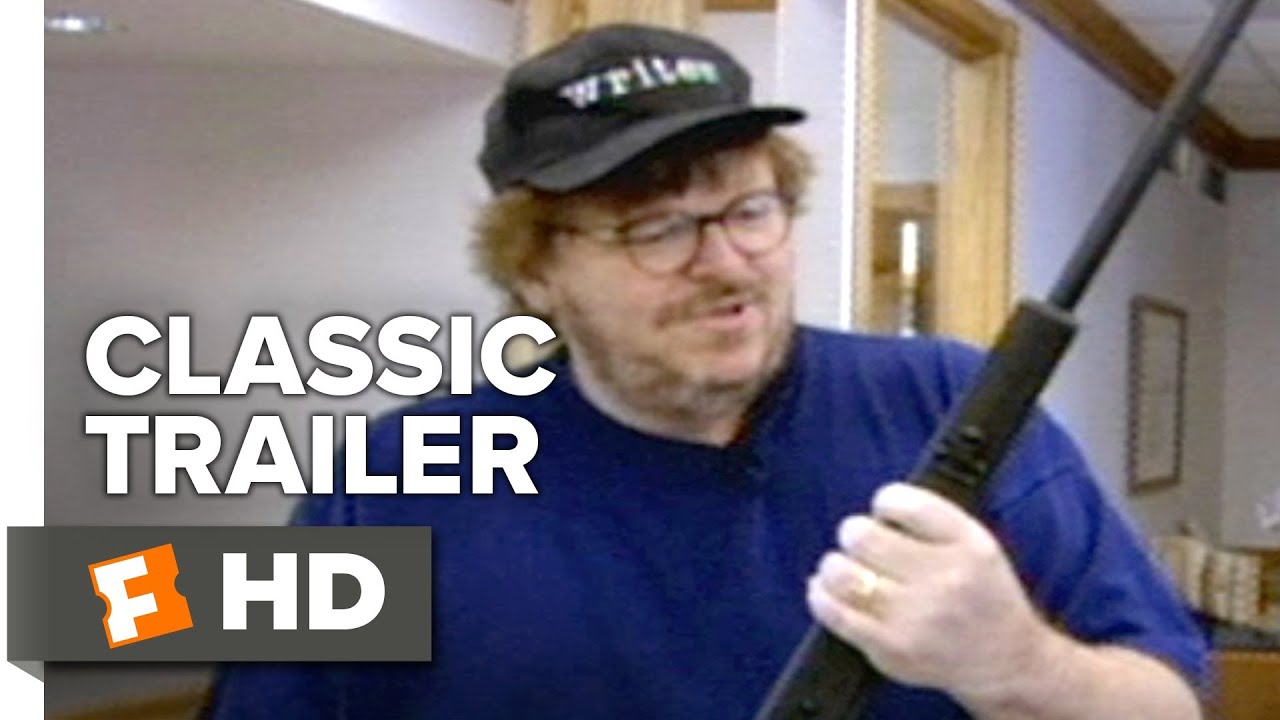
Michael Moore walked into a Kmart with two teenagers who still had bullets lodged in their bodies from the Columbine High School massacre. He didn't just ask for a refund. He asked for the corporation to stop selling the ammunition that had shattered their lives. It was raw. It was incredibly awkward to watch. It also worked.
The documentary Bowling for Columbine didn't just win an Oscar; it changed the way we talk about fear in America. Released in 2002, the film was a lightning rod. It still is. Some see it as a masterpiece of investigative journalism, while others view it as a manipulative piece of agitprop. Honestly, the truth probably sits somewhere in the messy middle. Moore wasn't just looking at gun control. He was looking at why Americans are so uniquely terrified of one another.
The Big Idea: It’s Not Just About the Guns
If you haven't seen it in a while, you might remember it as a "gun control movie." That’s a bit of a simplification. Moore spends a lot of time comparing the United States to Canada. He wanders around Toronto, famously finding unlocked doors and wondering why a country with plenty of firearms doesn't have the same body count.
He lands on the "Culture of Fear."
The film argues that the 24-hour news cycle and politicians thrive on keeping people scared. If you’re scared, you buy things. You buy security systems. You buy handguns. You vote for the person promising to protect you from the "monster of the week." It's a heavy concept that feels even more relevant in 2026 than it did in the early 2000s. We’ve traded evening news segments for viral TikTok algorithms, but the dopamine hit of fear remains exactly the same.
The Marilyn Manson Factor
One of the most profound moments in the documentary Bowling for Columbine isn't an explosion or a confrontation. It’s an interview with a guy in heavy makeup. At the time, the media was desperate to blame Marilyn Manson’s music for the Columbine shooting. They needed a scapegoat. They needed someone to point a finger at because looking at systemic issues is hard.
Manson comes across as the most rational person in the whole film. He tells Moore that the two shooters didn't care about his music; they were influenced by a society that ignores people until they do something horrific. When Moore asks Manson what he would say to the kids at Columbine, Manson says, "I wouldn't say a single word to them. I would listen to what they have to say, and that's what no one did."
That’s a gut punch. It shifts the blame from pop culture to a lack of empathy and community.
✨ Don't miss: Why American Beauty by the Grateful Dead is Still the Gold Standard of Americana
Fact-Checking the Controversy
We have to be real about the criticisms. Moore is known for "creative editing." For years, critics have pointed out that some timelines in the film are... let's say, compressed.
Take the famous scene where Moore gets a free hunting rifle for opening a bank account at North Country Bank & Trust. In the film, it looks like he just walks in, signs a paper, and walks out with a weapon. In reality, the bank had the rifles stored at a licensed gun dealer, and Moore had to go through a background check and pick it up there. He had the rifle brought to the bank for the sake of the shot. Does that invalidate the point? Not necessarily. The bank did have a promotion giving away guns. But it shows how Moore prioritizes the narrative punch over the literal, boring sequence of events.
There’s also the final confrontation with Charlton Heston, who was the president of the NRA at the time.
Moore cornered an aging Heston in his home. It’s a painful scene to watch. Heston clearly wasn't prepared for the debate, and Moore pushed hard. While many applauded Moore for "taking it to the top," others felt it was an unfair ambush of a man who might have been showing early signs of cognitive decline. It remains one of the most debated scenes in documentary history.
Why the Title Matters: The "Bowling" Mystery
Why is it called documentary Bowling for Columbine anyway?
It comes from a weird factual quirk. The two shooters, Eric Harris and Dylan Klebold, supposedly attended a bowling class at 6:00 AM on the morning of the massacre. Moore uses this to mock the idea that outside influences—like video games or music—cause violence. His logic: "They went bowling before the shooting. Why aren't we blaming bowling?"
It’s a sarcastic take on the media's obsession with finding a simple cause for a complex tragedy. It highlights the absurdity of the "blame game" that happens after every mass shooting.
🔗 Read more: Why October London Make Me Wanna Is the Soul Revival We Actually Needed
The Legacy of the Kmart Scene
The Kmart segment is arguably the most successful piece of "activist filmmaking" ever caught on tape. Moore took Mark Taylor and Richard Castaldo—two survivors—to the Kmart headquarters in Troy, Michigan. They didn't just protest. They brought the actual 9mm slugs that were still inside their bodies.
They wanted Kmart to stop selling handgun ammunition.
The corporate PR team was clearly panicked. The next day, Kmart actually announced they would phase out the sale of that ammunition. It was a rare, tangible victory. It proved that a documentary could be a tool for direct corporate change, not just a way to win awards at film festivals.
The Ripple Effect on Modern Media
Since 2002, the "Moore style" has become a blueprint. You see it in everything from Super Size Me to modern YouTube video essays. The filmmaker becomes a character. The "gonzo" journalism style—where the creator is part of the story—is now the standard.
But the documentary Bowling for Columbine hit differently because it was grappling with a wound that was still wide open. The Columbine shooting had fundamentally changed the American psyche only three years prior. Moore tapped into a collective trauma and asked, "Are we okay?"
The answer, according to the film, was a resounding "No."
The Statistics That Stay With You
Moore uses a "brief history of America" animation that is incredibly polarizing. It’s stylized and biting. It traces American history through the lens of fear—from the pilgrims being afraid of the wilderness to the modern era of being afraid of "the other."
💡 You might also like: How to Watch The Wolf and the Lion Without Getting Lost in the Wild
While the animation is satirical, the numbers Moore flashes on the screen are real data points from that era. He compares gun-related deaths per year:
- Japan: Fewer than 100
- United Kingdom: Fewer than 100
- Germany: Fewer than 200
- Canada: Fewer than 200
- United States: Over 11,000
Even if you account for population differences, the gap is a canyon. Moore’s point wasn't that other countries are perfect. It was that the U.S. has a specific, violent outlier status that we’ve somehow accepted as "normal."
Is It Still Worth Watching?
Honestly? Yes.
Even if you disagree with Moore’s politics, the film is a masterclass in pacing and emotional manipulation. It’s a time capsule of the post-9/11 era—a time when the country was high on patriotism but deeply paranoid.
The film doesn't offer easy answers. It doesn't give you a 5-step plan to end violence. It just forces you to look at the uncomfortable reality of a society that is armed to the teeth and terrified of its own shadow.
Actionable Takeaways for Viewers
If you’re revisiting the film or watching it for the first time, keep these things in mind to get the most out of the experience:
- Watch for the Editing: Pay attention to how Moore uses music to contrast with imagery. He often plays upbeat or "patriotic" music over footage of tragedy to highlight irony.
- Research the Context: Remember this was filmed before the era of smartphones and social media. The "fear" Moore talks about was filtered through three major TV networks and local newspapers.
- Check the Rebuttals: To get a balanced view, look up "Bowling for Truth." It’s a famous critique that breaks down the specific editing choices Moore made. Understanding the "other side" makes the documentary more interesting as a piece of media.
- Look at Modern Stats: Compare the 11,000 deaths mentioned in the film to current CDC data. It provides a sobering perspective on how little—or how much—has changed in twenty-plus years.
- Evaluate the "Fear" Argument: Ask yourself if you feel safer today than people did in 2002. Does the "culture of fear" argument hold up in the age of the internet?
The documentary Bowling for Columbine remains a provocative piece of work. It’s loud, it’s biased, and it’s deeply human. It asks the one question that we still haven't found a way to answer: why are we like this? Until we figure that out, this movie will remain relevant, whether we want it to be or not.