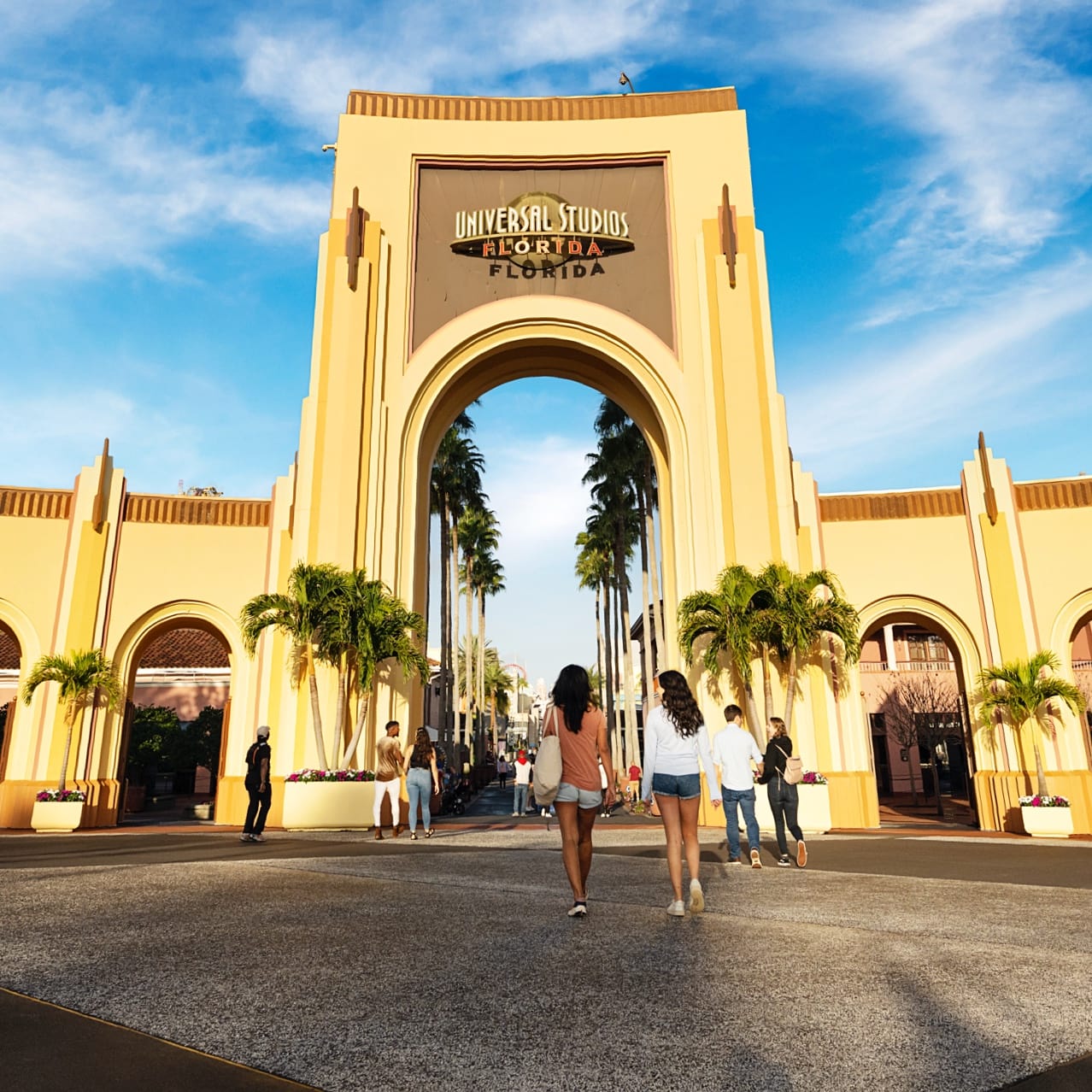
You’re standing in line for Hagrid’s Magical Creatures Motorbike Adventure, sweating through your t-shirt, and staring at a brick wall. It feels like a self-contained universe. But if you pull back—way back—the illusion breaks in the best possible way. An aerial view of Universal Studios Orlando reveals a mechanical masterpiece of logistics, hidden backstage corridors, and surprisingly tight geometry that you’d never notice from the ground. It’s basically a giant, high-stakes puzzle.
Honestly, the scale is deceptive. When you're walking from CityWalk to Islands of Adventure, it feels like a trek. From a helicopter or a high-res satellite feed, you realize the entire resort is a dense urban island surrounded by the sprawling suburban sprawl of Orlando.
The Grid Behind the Magic
Look at a drone shot of the park. You’ll see it immediately. The "back of house" areas are just as large as the guest areas. It’s wild. While you're enjoying a butterbeer, there’s a massive network of industrial warehouses just a few hundred feet away. These aren't just storage sheds; they are the literal lungs of the park.
Most people think the parks are round. They aren't. Universal Studios Florida—the original park—is shaped roughly like a jagged rectangle, while Islands of Adventure is more of a deliberate circle built around the Great Lake. From above, the contrast is stark. The Studios park looks like a film lot because, well, it was designed as one. You see the flat roofs of the soundstages, which look like boring beige boxes from the sky, but contain entire worlds like Revenge of the Mummy or Men in Black: Alien Attack.
It’s kind of funny how much of the park is just... roof. Massive, flat, gray expanses.
✨ Don't miss: Woman on a Plane: What the Viral Trends and Real Travel Stats Actually Tell Us
Why the Aerial View of Universal Studios Orlando Changes Your Perspective
If you check out Google Earth or recent flyover footage from creators like Bioreconstruct on X (formerly Twitter), you notice the proximity of the "real world." The I-4 highway is right there. It’s right there! From the ground, Universal uses "sightline engineering" to hide the outside world with trees, berms, and tall buildings. From the air, you see how thin that veil actually is.
Take a look at the VelociCoaster. From the sky, it looks like a tangled mess of black spaghetti. You can see how the track weaves over and under itself, occupying a footprint that is surprisingly small for a ride that feels that expansive. It’s an engineering flex.
- The Jurassic Park area is a dense canopy of green that looks like a literal jungle from 1,000 feet up.
- The parking hubs—the King Kong and ET garages—are massive concrete monsters that dominate the northern edge of the property.
- Volcano Bay’s Krakatau volcano looks like a lone, majestic spike sticking out of a sea of tropical blue.
The Epic Universe Factor
We can't talk about the view from above without mentioning the massive construction site to the south. Epic Universe is the new player. Looking at aerial photos of this new park compared to the original resort shows just how much Universal is growing. The original two parks are cramped. They are landlocked. They have nowhere to go. Epic Universe, seen from a bird's eye view, is a massive radial design with a central hub that makes the old parks look almost quaint.
The distance between the main resort and Epic Universe is a few miles. From a high altitude, you can see the dedicated bus lanes being carved out to connect the two. It’s a logistical nightmare that they’re turning into a science.
🔗 Read more: Where to Actually See a Space Shuttle: Your Air and Space Museum Reality Check
Hidden Details Only Drones See
Ever noticed the "show buildings"? These are the giant warehouses that house rides like Transformers: The Ride-3D. From the street, the facade looks like a city block. From the air, you see the facade is just a thin shell glued onto a giant box. It’s the ultimate "don't look behind the curtain" moment.
There's also the water management system. Orlando is basically a swamp that we convinced to hold buildings. From above, you can see the intricate network of canals and retention ponds that keep the parks from flooding during those inevitable 3:00 PM Florida downpours. The water in the parks isn't just for show; it’s part of a massive drainage infrastructure.
The Logistics of the "Universal Bubble"
If you’ve ever stayed at Cabana Bay or Sapphire Falls, you know the garden walkways. From the air, these look like turquoise ribbons snaking through the tropical landscape. They’re beautiful, but they also serve a purpose: keeping foot traffic away from the service roads.
Speaking of service roads, the perimeter road that circles the parks is constantly buzzing. From the air, you’ll see semi-trucks delivering food, technicians moving ride vehicles, and trash being hauled away. It’s a city that never sleeps, even when the gates are locked.
💡 You might also like: Hotel Gigi San Diego: Why This New Gaslamp Spot Is Actually Different
Practical Ways to Get This View (Legally)
Don't fly your own drone. Just don't. It’s a No Fly Zone (NFZ) for a reason, and you'll get a visit from security or the FAA faster than you can say "Expelliarmus."
If you want that aerial view of Universal Studios Orlando for yourself, you have a few options. The easiest is the Doctor Doom’s Fearfall at Islands of Adventure. When you’re at the very top, look North. You get a split-second, panoramic view of the entire resort, the Orlando skyline, and the endless sea of tourist traps on International Drive.
Another way? Book a room on a high floor at the Aventura Hotel. The floor-to-ceiling windows offer a stunning vista of Volcano Bay and the back of the Studios park. It’s arguably the best view in the city for theme park nerds.
What You Should Do Next
If you're planning a trip or just obsessed with the layout, start by pulling up a satellite map and toggling the 3D view.
- Trace the Hogwarts Express track. You’ll see it’s not a straight line and actually runs behind the scenes of the park through some very un-magical looking industrial areas.
- Look at the lagoon. Notice how the water isn't as deep as it looks. You can often see the tracks for the night show fountains just below the surface in high-res imagery.
- Compare the footprints. Compare the size of Diagon Alley to the rest of the park. It’s tiny! The fact that it feels so huge when you’re inside it is a testament to incredible theme park design.
Check out the latest flyover videos from reputable aerial photographers who have the permits to fly nearby. It's the best way to see the progress on new attractions like the rumored Fast & Furious updates or the massive expansion of the Epic Universe site without leaving your couch. Understanding the geography makes your next walk through the turnstiles a lot more interesting. You’ll start noticing where the "real" buildings end and the "show" begins.
For the most up-to-date visual progress, follow the community of Orlando-based aerial photographers who document the shifting skyline of the parks weekly. They catch the small details—like new coaster track being bolted into place or the painting of a new facade—long before the general public even knows what's happening. Study the maps, learn the "backstage" layout, and you'll never look at a theme park the same way again.