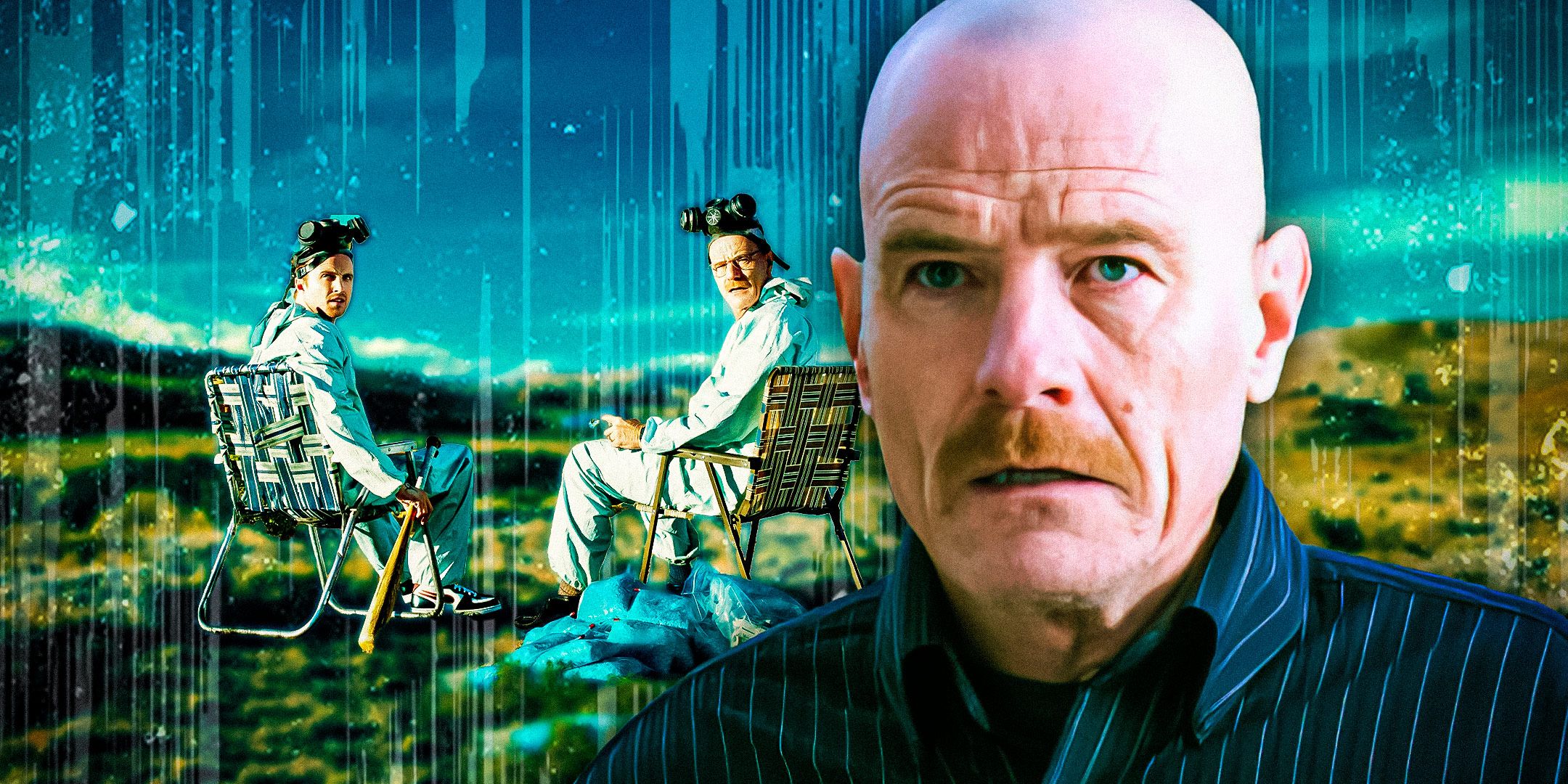
If you rewatch season 3 Breaking Bad today, you’ll notice something uncomfortable. The show stops being a "dad with cancer" story and turns into a horror movie where the protagonist is actually the monster. It’s the year of the Cousins, the year of the blue sky, and most importantly, the year Walt decides he isn't just doing this for his family anymore. He’s doing it because he’s good at it.
People forget how slow the burn was.
Vince Gilligan and his writing team—people like Peter Gould and Gennifer Hutchison—didn't just jump into the action. They let the tension simmer. We start with a literal scorched earth after the Wayfarer 515 plane crash. Walt is sitting by his pool, burning money. It's erratic. It's messy. Honestly, it’s the most human we see him before the ego completely takes over his personality.
Why Season 3 Breaking Bad Changed Everything for TV
Before this season, prestige TV usually had a "reset" button. You’d have a big finale, then things would sort of stabilize. Not here. The fallout of Jane’s death and the plane crash hangs over every single frame of the first few episodes. Skyler finally finds out. That’s the big one. When she looks at Walt and says, "Walt, get out," the show shifts from a crime drama to a psychological war zone.
The introduction of Gustavo Fring as a series regular changed the stakes.
In the first two seasons, the villains were chaotic. Tuco Salamanca was a loose cannon. He was scary because he was unpredictable. But Gus? Gus is scary because he is a mirror. He shows Walt what a "professional" looks like, and Walt spends the rest of the season trying to prove he can play at that level. This leads us directly to the Superlab. That gorgeous, terrifying, multi-million dollar basement under a commercial laundry.
The Cousins and the Philosophy of Silence
Marco and Leonel Salamanca, the Cousins, are probably the most divisive part of the season. Some fans thought they were too "terminator-like" for a show grounded in reality. But look at their purpose. They represent the inevitability of Walt's choices. They don’t talk. They just move. The scene where they sit on the bed while Walt showers is pure nightmare fuel.
It’s about the debt. The "blood for blood" mentality of the cartel.
While Walt is busy arguing about his ego and his "product," these two are moving like a force of nature to kill him. It forces a collision between the corporate evil of Gus Fring and the primal, vengeful evil of the Juarez Cartel. Hank Schrader gets caught in the middle of this, leading to "One Minute," which is arguably one of the best hours of television ever produced.
The Jesse Pinkman Problem
Poor Jesse. Honestly, by the time we get deep into season 3 Breaking Bad, Jesse is a ghost of himself. He’s coming out of rehab, trying to "accept" who he is. He calls himself the "bad guy."
But he isn't.
That’s the tragedy. Jesse thinks he’s a hardened criminal because he’s selling meth to people in recovery meetings, but he still has a soul. Walt has none left. This friction peaks when Jesse discovers that Gus’s dealers are using children—specifically Tomas, the brother of Jesse’s new interest, Andrea—to commit murders.
When Jesse decides to go after those dealers, he’s acting on a moral impulse. When Walt drives his Aztec into those dealers and shoots one of them in the head, he’s acting on a survival impulse. "Run," he tells Jesse. It’s the moment their bond becomes a suicide pact.
The Gale Boetticher Factor
Gale was too pure for this world. Not "pure" in the sense that he was a good person—he was making high-grade meth, after all—but he was intellectually pure. He loved the chemistry. He loved the coffee. He worshipped Walt’s talent.
Gale was the replacement.
Gus knew Jesse was a liability. He wanted a team of two professionals: Walt and Gale. But Walt knew that as soon as Gale learned his method, Walt would be "retired" (read: murdered). The manipulation of Jesse to kill Gale in the finale, "Full Measure," is the most evil thing Walt does in the entire series up to that point. He destroys Jesse's remaining humanity to save his own skin.
He didn't have to do it that way. He chose to.
Breaking Down the Visual Language
The cinematography in this season, led by Michael Slovis, moved toward a much harsher, high-contrast look. Think about the yellow tint of Mexico versus the cold, clinical blue of the Superlab.
The lab is a character.
It’s clean. It’s industrial. It represents the "Business" side of the drug trade that Walt thought he wanted. But the lab is also a cage. The more time they spend down there, the more trapped they become. You see it in the framing; the camera often peeks through pipes or from high angles, making Walt and Jesse look like rats in a maze.
What Most People Miss About the Fly Episode
"Fly" is the most misunderstood episode of the entire run. People call it filler. It’s not. Directed by Rian Johnson, it’s a bottle episode that serves as a fever dream confession.
Walt is exhausted. He’s losing control. The fly is a "contaminant," but it’s not about the meth. It’s about his guilt over Jane. He almost tells Jesse. He’s right on the edge of admitting he watched her die. If he had said it then, the rest of the series wouldn't have happened. But he doesn't. He catches the fly, the "purity" is restored, and he goes back to being a liar.
It’s a masterpiece of tension.
The episode costs less to produce, sure, but it does the heavy lifting of showing us Walt’s deteriorating mental state. He’s obsessed with perfection because his life is falling apart. His wife hates him, his son is confused, and his boss is a psychopath who wants him dead. The fly is the only thing he can try to control.
Practical Takeaways for a Rewatch
If you’re going back through the series, pay attention to these specific shifts in season 3. They change how you view the ending of the show.
- Watch the Wardrobe: Walt starts wearing darker colors. The "beige" Walter White is dying. He’s stepping into the Heisenberg black and green.
- The Power Dynamics: Notice how Gus never raises his voice. His power comes from silence and stillness. Compare that to Walt’s frantic, loud energy. It shows who is actually in charge.
- The Breakfast Scenes: They aren't just memes. The tension at the White dinner table is a barometer for how much the "Heisenberg" life is leaking into the "Walter" life. By the end of the season, there is no separation.
- Hank's PTSD: Watch Dean Norris’s performance. He goes from a comic relief "bro" to a broken man suffering from severe panic attacks. It’s one of the most realistic portrayals of trauma on TV.
The season ends not with a bang, but with a gunshot in a small apartment. Jesse pulls the trigger on Gale, and the screen goes black. It’s the point of no return. You can’t go back to being a chemistry teacher after you’ve ordered a hit on an innocent nerd. You can’t go back to being a "good kid" after you’ve committed murder.
The board is set for the total war of seasons 4 and 5.
To truly understand the show, you have to accept that season 3 is where the "hero" died. Everything after is just the aftermath of a man deciding that his pride was worth more than anyone else's life. If you want to dive deeper into the production, look up the "Better Call Saul" insider podcasts where they frequently reference the technical hurdles of the Superlab set—it was actually built as a practical location, which is why it feels so claustrophobic and real.
Next time you watch, track the number of times Walt lies to Jesse versus the number of times he tells the truth. The ratio is staggering. It’s the ultimate masterclass in manipulation.