You’ve probably seen a dozen different anime power systems, from the spiritual pressure in Bleach to the complex nen contracts in Hunter x Hunter. Most of them feel like magic with a different coat of paint. But a My Hero Academia quirk isn’t really magic. It’s biology. Horikoshi Kohei, the creator of the series, built this entire world on the idea that these powers are essentially just weird physical evolutions—like having an extra limb or a highly specific allergy.
It changes everything.
When we first meet Izuku Midoriya, the world seems simple. You’re born with a power, or you aren’t. But as the story grinds on, we realize that having a quirk is actually kind of a burden. It’s messy. It’s dangerous. And honestly, it’s probably going to lead to the end of the world if the "Quirk Singularity" theory turns out to be right.
How a My Hero Academia Quirk Actually Functions
Most people think of quirks as just "superpowers," but they’re officially classified as "paranormal abilities" that manifested first in a glowing baby in Qingqing City, China. From that point on, humanity shifted. The biology of a My Hero Academia quirk is tied to a specific physical trait: the pinky toe. If you have two joints in your pinky toe, you’re quirkless. If you have one, you’re part of the 80% of the population that’s evolved.
It’s such a small, weird detail. I love it.
These powers usually show up by the age of four. Sometimes they’re hereditary, a perfect blend of Mom and Dad’s abilities, like Shoto Todoroki’s Half-Cold Half-Hot. Other times? You get a "mutation." These are the wild cards. Eri’s Rewind quirk is a prime example. It didn’t come from her parents; it was a total genetic fluke that ended up being one of the most terrifyingly powerful forces in the series.
The Three Main Categories
You can basically bucket every quirk into one of three types, though the lines get blurry the deeper you go.
First, there are Emitter quirks. These are the flashiest. Think Endeavor’s Hellflame or Katsuki Bakugo’s Explosions. They require conscious effort to "turn on" and usually involve releasing something from the body. Bakugo isn't just making explosions out of thin air; he’s sweating nitroglycerin-like sweat and igniting it. If he’s too cold, he can’t sweat. If he can’t sweat, he’s useless. That’s the biological limitation that makes the writing so tight.
Then you’ve got Transformation quirks. These allow the user to temporarily change their body. Kirishima’s Hardening or Himiko Toga’s Transform fall here. The key is that it’s temporary. If Kirishima stays hardened for too long, he gets exhausted. It’s like a muscle cramp, but your whole skin is rock.
Finally, we have Mutant quirks. These are permanent. Tsuyu Asui (Froppy) is always a frog. She doesn’t "turn on" her frog powers; she just has a long tongue and sticky hands 24/7. This category is where the social commentary of the series really bites. If you look like a "monster" because of your quirk, society treats you differently. Shoji, with his multiple arms, wears a mask for a reason. Spinner’s entire villain arc is rooted in the racism—or "quirkism"—he faced as a lizard-type mutant in a rural town.
The Quirk Singularity: The Dark Side of Evolution
Garaki, the creepy doctor working for All For One, proposed a theory called the Quirk Singularity. It’s basically the idea that quirks are getting stronger and more complex with every generation. Eventually, the human body won't be able to handle them.
Think about it.
In the early days, maybe someone could just puff a little smoke from their ears. Fast forward a few generations, and you have kids like Bakugo who can level buildings. Eventually, a child will be born with a power so massive their own body just... breaks. Or they destroy everything around them before they even know how to talk. We see the start of this with characters like Dabi. His quirk, Cremation, is way too powerful for his body. He has his mother’s "ice" constitution but his father’s "fire" power. He’s literally burning himself alive every time he uses his strongest moves.
It’s a ticking time bomb.
Why One For All and All For One Break the Rules
Every My Hero Academia quirk has a limit, except for the two big ones at the center of the conflict. One For All is a "stockpiling" quirk. It’s a torch passed from person to person, getting hotter and more intense with every handoff. By the time it gets to Deku, it’s not just super strength anymore. It’s a library of all the previous users' quirks.
This is where the story gets controversial for some fans.
Some people feel that giving Deku multiple quirks (Blackwhip, Float, Gearshift, etc.) ruined the "underdog" vibe. I get that. But narratively, it proves the Singularity theory. Deku’s body literally starts falling apart because One For All has grown too heavy for a human "vessel" to carry.
On the flip side, All For One is the ultimate predator. He can just take what he wants. But even he has a "storage" issue. He needs a specific kind of hateful, strong-willed successor (Shigaraki) because his original body reached its hardware limit decades ago. He’s running Windows 11 on a 1995 processor. It doesn't work.
The Practical Reality of Living with a Quirk
We focus on the heroes, but imagine being a regular guy with a My Hero Academia quirk that just makes your head a spray bottle. Or you can make your eyes pop out two inches. That’s the reality for most people in this world.
There are actual laws—the Quirk Restriction Laws—that stop people from using their powers in public. You can’t just fly to work because you have wings. You’d get a ticket. It’s a hyper-regulated society that tries to pretend these god-like powers are just "personal quirks," hence the name. The shift from "Paranormal Ability" to "Quirk" was a calculated PR move by the government to make people feel like their powers were just cute personality traits rather than weapons of mass destruction.
Training and Overheating
Quirks are muscles.
If you use them too much, you "break" them.
Shoto gets frostbite.
Kaminari fries his brain and turns into an idiot for an hour.
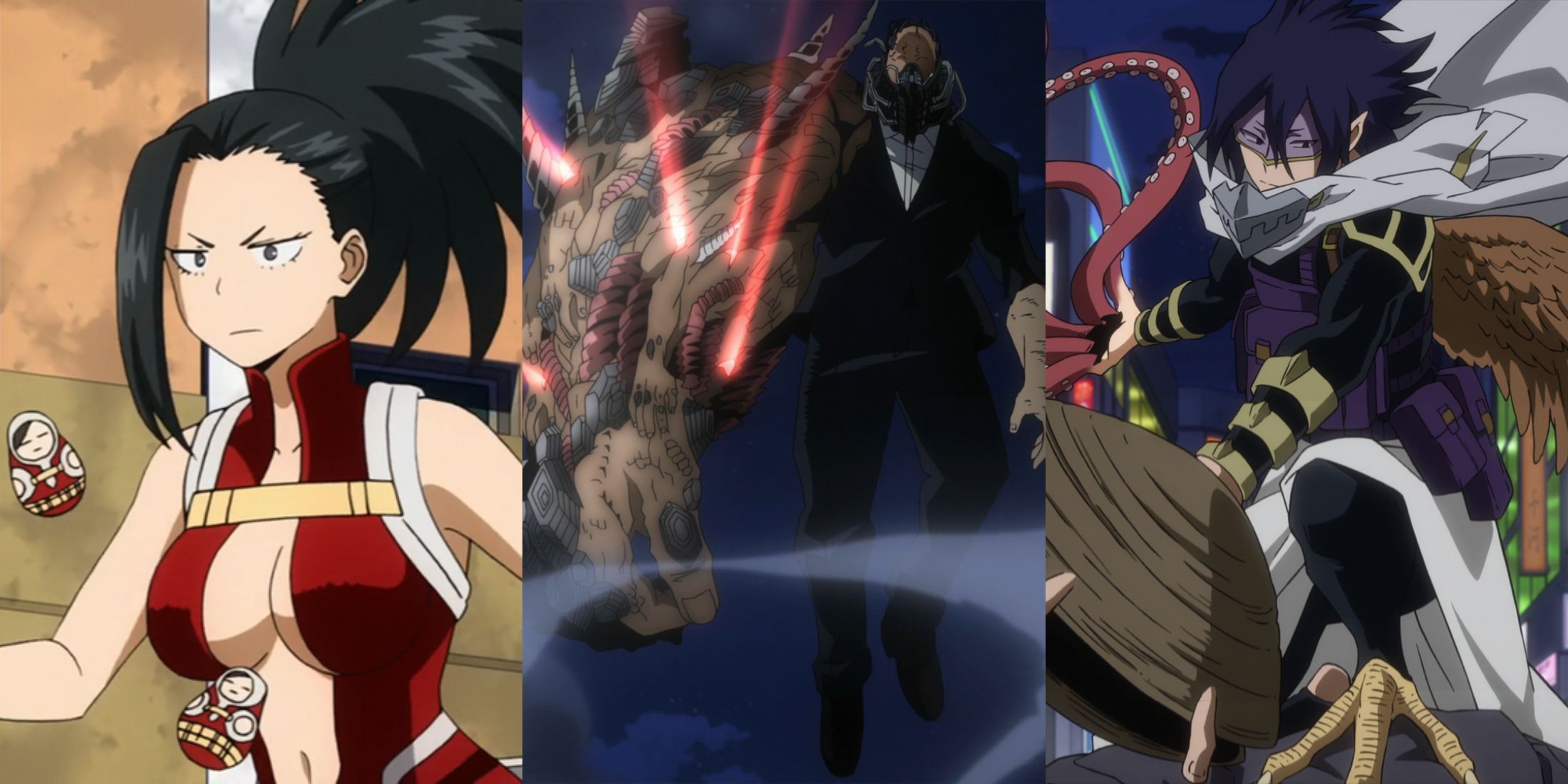
Momo Yaoyorozu literally has to eat massive amounts of food because her Creation quirk uses her body’s fat cells at a molecular level to build objects.
If she’s skinny, she’s out of ammo.
This is why the training camps in the series are so brutal. They aren't just learning how to fight; they’re trying to increase their "capacity." It’s like weightlifting for your soul.
What Most People Get Wrong About Quirk Marriages
The "Quirk Marriage" thing is often misunderstood as just a trope. In the lore, it was a legitimate, albeit highly unethical, social trend during the second and third generations of quirks. People weren't marrying for love; they were essentially breeding for power. Enji Todoroki (Endeavor) is the poster child for this. He didn't just want a kid; he wanted a "tool" that could surpass All Might.
The result? A family shattered by the pressure of biological expectations.
It’s a reminder that in this universe, your My Hero Academia quirk often defines your value to society before you even have a chance to decide who you want to be. It’s a deterministic nightmare masked as a superhero fantasy.
Assessing Your Understanding of Quirk Logic
If you're trying to analyze how these powers work—maybe for a fan project or just to win an argument on Reddit—you have to look at the "Drawback." If a power doesn't have a clear physical cost, it's not a true quirk within Horikoshi's rules. Even the strongest characters have a wall they eventually hit.
Actionable Insights for Engaging with the Series:
- Analyze the lineage: Whenever a new character is introduced, look at their name. Horikoshi loves puns. Usually, the character's name contains kanji that describes their quirk (like "Bakugo" containing the character for explosion).
- Check the "Vessel" logic: If a character is struggling, ask if it’s a mental block or a physical one. Most of the time in MHA, the "power up" comes from pushing the body's physical threshold, not just "wanting it more."
- Observe the background characters: The "filler" characters in the crowds often show the most creative (and useless) mutant-type quirks, which really fleshes out the world-building beyond the top 10 heroes.
The world of MHA is ending its run, but the way it handled power scaling through biological limits is something other mangakas will be studying for years. It’s not just about who hits harder; it’s about whose body can survive the hit.
For those looking to dive deeper into the specific mechanics of the top-tier powers, start by re-examining the "Provisional Hero License Exam" arc. It’s the best showcase of how quirks interact with environment and strategy rather than just brute force. Pay attention to how the students use their drawbacks to bait enemies—it’s the peak of the series’ tactical writing.